My Posts

CRISIS : A STEPPING STONE

The times of crisis always changes the world. Great Individuals and Organisations lead this change and mediocre one’s perish. The crisis is always the best time to introspect. Focus should be inwards. What it actually gives, is time to make necessary, but neglected changes. This is true for both individuals & organisations. This looks a very obvious step but where people majorly fail is in implementation / action.

Having said that let me help you in charting this course / steps : What are these changes? How can one find what changes are needed? What to be done to implement the changes?

Let’s Dive in:

How can you find what changes are needed?

The most important aspect to change is to accept that change is required. Many individuals and organisations are always on negation mode. We always feel that we are doing the best we can and there is nothing to improve or nothing to change. So the following steps are very important:

  1. Accept that there is always scope of improvement in the process / efficiency.
  2. Find the bottle necks / areas where there is always a hand to mouth situation.
  3. Find areas that are always part of discussions –

INDIVIDUAL: I cannot find time / I cannot read so much / I do not get motivated / etc. ORGANISATIONS: we have less people / we have older machines / we have less time for the same.

In short – List the NEGATIVE comments that are commonly discussed, find solutions for the same.

Examples are better teachers & easy for understanding the concept:

INDIVIDUAL: I never get time for reading books / exercise, is it only me? I am sure its with all of us. Use this Crisis to change that. How? You have been working from home – so you are saving time on travelling to office / to customers. Utilise this time for reading & exercise. You can best do alternate day and do both the activities. Take control of your time.

ORGANISATIONS: Setting processes correct is always a neglected issue when the sales is going good. Organisations have least priority on the same & rightly so, Sales is the first priority as it generate revenue / resources are overloaded. Now, the crisis is best time, as in here resources are not overloaded. Use this opportunity to set correct processes to increase overall efficiency.

How can we implement the change?

Once you have identified the task half the battle is won. You can only make progress if you take actions on the same.

  1. Have a brain storming session with stake holders to understand what are the pain points & how they can be eliminated.
  2. List out the highest priority pain points, elimination of which will significantly increase efficiency.
  3. Put a clear action plan with roles and responsibilities.
  4. Keep tracking the progress and make changes in line with the plan.

So to sum up following steps can make Crisis as a stepping stone instead of a showstopper.

  1. Identify the bottlenecks / pain points.
  2. Create a plan for resolution / elimination of the same with clear responsibility.
  3. Track progress and guide way to final achievement – Increase in efficiency.

I can confidently say that this will surely help in bouncing back better and managing costs to the “Tee”.

I would also like to know your ideas to increase efficiency, please share the same in comments.

Welcome to Beyond Obvious

Hello Friends!

As the name suggests you might get to read a few things where there is more than it actually meets the eye & that too from a vantage point that is beyond obvious.

Hope you enjoy this blog & I am able to satiate the thirst of you readers. JUMP IN.

5 Steps to achieve Customer Intimacy

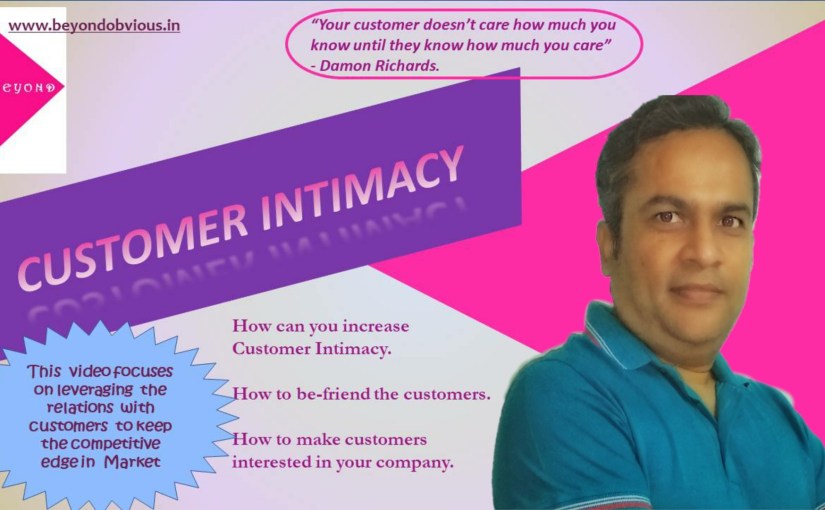
Today we not only talk about customer delight / customer satisfaction we talk about customer intimacy.

What is Customer Intimacy?

How to make customers interested in your business?

How to achieve Customer Intimacy?

These steps should help you have a lot of important information, considerably easily & lightning fast.

5 SUCCESSFUL BUSINESS STRATEGIES

Strategy by definition means: A plan of action designed to achieve a long term or overall aim.

Every organisation defines there strategy for business and while some fail many succeed at it. So what is the difference? Difference is highlighted in below Quote perfectly:

Above all, Success in business requires two things: a winning competitive strategy & superb organisational execution

Stephen Covey

In this article I will take you through the examples and details of some strategies but first let’s just simplify the Strategy into 5 broad categories:

  1. Product based: In  this the Product is the centre of strategy.
  2. Customer based: Customer Experience / requirements at the centre.
  3. Idea / Concept based: Basically a Gap in Supply – Demand / Demand creation is at the centre of strategy.
  4. Demographics based: A certain region / class / age etc. is being focused in this Strategy.
  5. Competition: Targeting competition and its products to highlight your products / offerings.

Now lets dive in to details in each of these categories:

PRODUCT BASED:

 This is for both the Product & Service. Here the main focus is on developing the Product or Service that bridges the gap between the demand and supply to make a strong business case.

Let’s talk about IKEA – there moto has been to create a better every day life for masses. They have variety of quality products which are functional, budget priced, stylish. So they managed to find a niche for themselves and developed a product / brand to serve and monetise.

On service front, we all know a lot of apps in this category – food delivery, shared cabs, radio cabs, logo design, etc.

To discuss about an innovative idea is a small company Dunzo. In layman’s language they are the local courier, minus the disadvantage of dropping the package at the courier shop. They found the pain point and provided an end – to – end solution. Pick-up and Drop packages and that too at a reasonable cost. My daughters school book set was delivered by Dunzo during the last phase of lock-down. They not only deliver documents but cakes as well.

In here the Product Idea is in front of every ones eyes, but the main aspect is finding the Gap and then executing the delivery strategy that is most important.

CUSTOMER BASED:

On a regular basis we find companies launching products, competing in markets, beating the competition & winning the sales – this is typical Product based strategy. Another strategy is Customer Based (I call this a copy-cat strategy). You do not need to be innovative, you just need to have money power to buyout or a strong team to replicate the product.

Microsoft has pioneered this game by far, than any other brand. Its simple for them, let some one do the effort of product launch, testing the market, troubleshooting, etc. Once the product is established, MS will either buyout the company / launch a similar product.

Right in the start they bagged a order from IBM for the operating system, then acquired a small company Quick & Dirty Operating Systems (QDOS), modified there OS to make MS-DOS.

Excel was influenced by VisiCalc & Lotus 1-2-3. Word was heavily similar to a popular software Word Perfect. Powerpoint was acquired from a small San-Fransico company.

To dethrone a popular browser – Netscape, they licensed a browser from Spyglass.

X-Box – Sony Playstation / Nintendo.

There are many such examples. Currently they are focusing on Google with MS team sitting right in Bay Area, in backyards of google.

With its base product the Windows ruling the PC market – they have a strong platform for cross selling. Look at MS Team’s a competitive product to Webex, they are offering it with MS Office as a bundle deal.

IDEA / CONCEPT BASED:

Japan has been predominantly as Tea drinking country, in 1970’s Nestle wanted to push coffee to this tea drinking nation. They hired a psychologist Clotaire Rapaille who mentioned that Japan has no connect with coffee and they will not accept the same,  he suggested Nestle to add coffee flavours in there sweets. This made the young Japanese people accept the taste of coffee from a very young age. This brought about an amazing benefit to Nestle.

From nil coffee sales in 1970 – Today Japan is 3rd Largest Importer of Coffee in the world. In the instant coffee segment Nestle leads the  market.

So the example is self-explanatory on how an idea / concept based strategy is implemented, driven and can create a huge first mover advantage in the target markets.

The key to this strategy is knowing the pulse of the market. Understand the culture, create an emotional bonding for your product / service.

DEMOGRAPHICS BASED:

In India people are very innovative and they can sell any product on the demographic base. Will the comb be different for men & women? Does the soap need to be different? razor / toothpaste / shampoos / cars / etc.

But day in day out we see this happening on our TV. Toothpaste with a Cartoon character – targeted to your kids, with pink, floral design at your wife and regular targeted at you. So a family of 3 buys 3 toothpastes.

Recently you would have seen a health drink Women’s Horlicks,  Different versions of Shampoos are being targeted at Men & Women, even Face wash are being differentiated between Men and Women.

Above may seem and intelligent idea but these are not so good examples.

Let’s again look at Nestle. When they launched the famous Kit Kat in japan they slightly changed the brand name to “Kitto Katto”. This was a runaway success due to  its similarity to the famous phrase “Kitto Katsu” which means “never fail” / “you will win”. So Kit Kat also became a famous gift product.

Another such example is of the ITC’s Engage Pocket Perfume. They absolutely created a market niche with this innovative product packaging – Pocket Perfumes. Engage (ITC Brand) was first to put perfume in a small pocket friendly packaging. They targeted the teenagers, who would always want to be ready and are always on the go. It wasn’t easy to carry heavy bottles of perfume everywhere, so they created this niche and all other players had to follow.

COMPETITION BASED:

We have all seen a lot of Rivalries & competition targeting, Cola Vs Pepsi, Kingfisher Vs Jet, Microsoft Vs Apple. Main motive here in, is always to highlight what rival misses and take a pot shot at competition.

Let’s look at a little know rivalry which went on to edge of the wire. Dunkin Donuts Vs Starbucks in USA.

Dunkin was a regular Donuts & fast food joint until around 2000. Then they decided to enter the coffee market, launched a variety of espresso’s, latte’s & cappuccino’s  in 2003. Around 2006 they started punching above their weight at Starbucks the by far a market leader.

They targeted Starbucks for there menu, lined up with Italian styled names on it. They advertised with customers having difficulty to order there brew. Though Starbucks did not indulge in this verbal battle, they insisted that quality of their coffee beans is way better than a fast food joint coffee seller.

Dunkin then launched a campaign “America runs on Dunkin” & there CEO also highlighted that they are a beverage company.

Today 60+ % of the coffee market in US is dominated by these 2 players. Around 40% by Starbucks and 20% by Dunkin.

What Dunkin did was by targeting a market leader in coffee segment they made a space for themselves. They created a alternate name in customer minds. So a coffee drinker searches for Starbucks / Dunkin.

So to conclude: It solely depends on organisations and there managements on which strategy they want to play in the markets. its also possible that at one time – multiple strategies could be played in for same products / different products.

Hope you liked this article – please subscribe to not miss such articles.

The Success Mantra – S & M

Companies should wake up to ever changing dynamics in market and focus on there spear head resource the Sales & Marketing departments to keep there edge in market.

In this video I highlight some of the key benefits that S & M team can drive for the organisations. This is First of the Six video series where I take you through detailed account of how to S&M teams should function and pull the customers towards there products / services.

In this video I take you through the above mentioned 3 Disruptions EV, 3D Printing & Digitisation and scale with which they will hit us in coming 3 to 5 Years.

Disruptions that will hit us in 3~5 Years.

Also visit the following blogs to know more the Sales & Marketing subject.

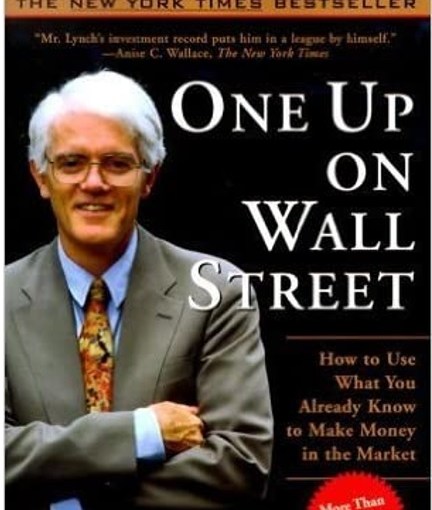
Summary of One Up on wall street – By Peter Lynch

Hello Friends

I just went through the book “One up on wall street by Peter Lynch. Though its a old book but i felt that the Lessons are very much prevalent to today’s / even future context. Its about the Investing Habits and Behaviours.

Though many people have summarised / made videos / info-graphics on the same, this is my attempt to make it simple while keeping the core intact.

Please feel free to download the pdf file below.

Please feel free to Like, Comment & Share your feedback on the same.

5 EXAMPLES ON LEADERSHIP

We all like stories and we all love strong leaders – let me take you through some very interesting examples.

Lets start with Satya Nadella & Microsoft:

“Longevity in this business is about being able to reinvent yourself or invent the future.”

Satya Nadela

He joined Microsoft in 1992, has since been associated with Bill Gates, Bill gates, to remind you has an authoritarian style of leadership, yet Satya has been retaining his own style. The that makes him Satya.

He was working on “AZURE” a Cloud platform on Microsoft. When he took over as CEO, Microsoft was struggling to find its feet in the world now dominated by Apple, Android & Amazon’s like new breed. Windows 8 had crashed, Android was in dominating position, Bing wasn’t able to get the juice out of google. Come Today – Microsoft is steady and doing good.

So how did Satya achieve this:

  1. Employee Trust: He wrote a letter to employees making them feel they were similar & the crux was “Family, Curiosity & Hunger for knowledge all define me.”
  2. Courage: Accepting the Rival OS Linux on Azure Cloud. MS Office for Apple iPad.
  3. Embracing the Change: He released Apps like MS Outlook & Office for Android & iOs.
  4. Innovative: He released first Microsoft Laptop – the Surface book, the Holographic Goggles – Holo lens.
  5. Vision: To put Microsoft where the customers are.

So to sum up the Qualities I think he displayed – Teamwork, Vision, Courage, calculated Risks, Embracing the change – in strategy, thinking, execution.

To know more on Satya Nadella find links below:

The Rise of Satya Nadella, Ten things to know @ Satya Nadella, Wikipedia: Satya Nadella

Let’s come to the Dada of Indian Cricket – Sourav Ganguly as we all know – the most aggressive of Indian Captains. Indians were never presumably so animatedly aggressive on the field till this man arrived on the scene as a captain. Who can forget the iconic swing of his shirt on Lord’s in 2002 Natwest Series. the Wisden Cricketers’ Almanack ranked him the sixth greatest ODI batsman of all time, next to Viv RichardsSachin TendulkarBrian LaraDean Jones and Michael Bevan.

He took the center stage when Indian Team was in rough waters over the match fixing scandals of 2000, from scratch on he built a team with young players like – Harbhajan Singh, Sehwag, Yuvraj, Mohammad Kaif, Irfan Pathan, Zaheer Khan, Dhoni, etc. along with seasoned – Sachin Tendulkar, Dravid, Laxman, Kumble, Srinath, etc. He lead this team to WC 2003 Final first time after 1986.

But what set him apart were following things:

  1. Building a Team: Pick & guide the young team mates to collaborate towards one Vision World Cup.
  2. Lead from the Front: May it be his aggression on the field, his fighting attitude, He had always lead from the front.
  3. Courage: He pushed a classic and successful middle order batsman like Sehwag to open for India & Indian cricket got its most explosive opening batsman. Took a lot of chances with Harbhajan & Irfan Pathan. Cancelled the IPL Opening Ceremony calling it waste of money.
  4. Innovative:  Asking Dravid to keep wickets or Tendulkar to bowl in one dayers, just so that one extra spot can be created for a specialist.
  5. Dynamism: When he rejected to be part of Ravi Shastri’s Videoconferencing Interview to choose Anil Kumble for India Coach, Answering all the sledgers on & off the field, Pushing his young team to potential. He was dynamic from the word go.

So to sum up the Qualities I think he displayed –Vision, Courage, calculated Risks, Team building & Lead from the front.

We are aware that Infosys is a golden goose of the Indian IT Industry, our own Garage to Great company. Let’s learn how Mr. Narayan Murthy made what Infy is today.

The sheer passion, group collaboration, fair & transparent management:

  1. Lead from the front: Mr. Murthy has always been on forefront to take Infy out of any issues may it be the Sexual Harassment case on Phaneesh Murthy in late 90’s or recent issues with Infy Books being cooked.
  2. Team Care: Infy distributed the stocks worth INR. 50,000 Cr to its employees after the IPO. Care for people and they will make you great.
  3. Integrity: We all know his favorite statement “In god we trust, every one else should bring data to the table”. He has been making decisions all and all data driven.
  4. Restructure: In 90’s when Infy was dependent on General Electric as a single biggest customer, he planned to diversify the customer base to protect profitability and reduce dependability on one customer.
  5. Merit Leadership: When we see nepotism in all Industrial, Government, Film Industry  & Businesses, he made a rule that no founder to continue in Infy after 65 Years & no founders kids work at Infy to avoid nepotism. He has even kept the requests from influential people at bay with Hire on Merit policy only.

So to sum up the Qualities I think he displayed –Vision, Integrity, Courage, Team, & Merit Importance.

In the India of late 70’s & Early 80’s, which was not so focused on equal opportunity & when women entrepreneurs were not so common. There was this one name which challenged the status quo – Kiran Mazumdar Shaw. She started Biocon in 1978 in collaboration with Biocon Biochemicals Ltd. Ireland in her own home garage. A JV with 70% ownership of Mrs. Shaw. She faced a lot of struggles due to her age, gender, etc. No Banks wanted to finance her, but she managed. From a enzyme manufacturer for Food Packaging, brewing & Textile to a Bio-Pharma stalwart taking full control of the company in 1998.

  1. Dynamism: From a father who was a brew master to being rejected jobs of Brew Master for being a female and entering into enzyme Business & then into Bop-Pharma.
  2.  Persistence: In a male dominated society & field she faced a lot of challenges to make  her organization the only Second Company to cross $ 1 Billion mark on First day of listing.
  3. Lead from the front: There is a incidence while Biocon was cracking a deal with Novozymes, her husband was detected with cancerous lump & yet she along with her domestic responsibilities went on to win the deal.
  4. Innovative: whether it’s the field she chose, business models, focus on R&D – innovative approach has been the forte for her.
  5. Emotional Quotient: All along the growth that Biocon has been scaling, she has been talking and contributing back to the society through Aarogya Raksha Yojana, Mazumdar – Shaw Medical Foundation, on Education & Infra. She is a strong crusader for betterment of Bangalore and India.

So to sum up the Qualities I think she displayed –Dynamism, Persistence, Courage, Innovative, & Emotional Quotient.

To know more on Kiran M Shaw find links below:

Kiran Shaw Blog, Wikipedia: Kiran Shaw, 5 Lessons from the Accidental Entrepreneur, Kiran Mazumdar Shaw

We can go on and on with individual leaders, but as my blog is named beyond obvious I bring to you a leadership example of a corporation. What best suits than the market leader in Passenger Vehicle segment – Maruti Suzuki.

MSIL started in 1981, merged with Suzuki in 1982. Currently its 52%+ owned by Suzuki Japan. MSIL hold 53%+ market share of the Indian Passenger car market. So, why do I consider it worthy to be mentioned in this Leadership example line up?

Its no joke that an organization holds 50+% market share in the country since its inception for close to  40 Years, against international competition for last at least 20~25 Years. Mind you, they are not the cheapest, not the best, not the most wanted products & yet they rule. So what are they doing Right and How? Let’s see.

  1. Dynamism: From the first 3 Box design in Maruti 1000, to small Maruti 800, to luxurious Baleno (old design) to SUV Vitara (old design) they did it all & continued. Some of these products were failures and yet they brought new ones.
  2. Connect: They currently have the best connect – with customer / dealers / workshops / garages. It’s the biggest USP for MSIL. You are never far from a MSIL Service Station.
  3. Innovative: They have been quite innovative on there approach, may it be launching products on continuous basis / venturing into complete new segments e.g. Carry (1 Tn Load carrier) or Ertiga (Light Utility Vehicle) / NEXA – Premium Cars separated from basic dealership / ARENA – Configure your car. This approach has been helping them keep there customers coming back to them.
  4. Lead from Front: This has been a great forte for them in country like India – They iconized a few of there USP’s in such a way that they made it the culture. Be it the tag lines like “Kitna Deti Hain?” or “Kya kare papa ji petrol khatam hi nahin honda?” they are itched in peoples mind and they always kept there USP untouched – no one can beat the fuel efficiency of MSIL.
  5. Vision: They planned a Battery Manufacturing Unit in there newly built Gujarat Facility in the wake of EV. Collaborated with Toyota for the Technology of EV’s. In the wake of BS6 announced they won’t launch a diesel engine. This hints that the company has vision on where they want to be in coming years.

So these were a few examples / stories of leaders and their leadership behaviours. Do Share & Like.

Another important aspect in leaders is Blindspot & I guess every one of us will have one, to elaborate

In his book Good to Great, wrote that the first job of a good leader is to;

“Get the right people on the bus (and the wrong people off the bus) before you figure out where to drive it.”

JIM COLLINS

The housing bubble, Enron, and Chernobyl are all great examples of things that were not accidents and were predictable for those that sought to look. Humans caused these things – humans making decisions and taking actions.

Keeping your antennae up regarding these sorts of predictable surprises is an important part of strategy and leadership.

Do share some more interesting stories you have in comments below. I would love to know. 

Change is Coming… Are you Ready?

Video on Disruptions that will hit us in coming 3 to 5 Years.

Many people around us think that the Changes happening around them are not going to Disrupt anything. That the Electric Vehicles are far away still Or that 3D printing can not disrupt manufacturing Or Digitisation is only for IT.

In this video I take you through the above mentioned 3 Disruptions and scale with which they will hit us in coming 3 to 5 Years.

Knowing is winning half the battle.

You would also like the following video on Sales & Marketing importance in today’s context

The Success Mantra – S & M

About Me

You reaching out to this page means that you are getting interested in beyondobvious.in. I appreciate your interest & that’s a good sign for me.

I am Nilesh Shah. 17 years of wide experience of Marketing and Sales in Auto Components, Capital Equipment’s, Chemicals, etc.

Have been in various roles from leading business verticals / certain geographies to product management, from front line sales to marketing strategy.

I am also a vivid reader and short stories & personal finance are my major interests.

In this blog I will try to bring in some fresh perspectives to the already known facts. I will try to bring out the knowledge from the information available.

Hope you people enjoy this blog and keep visiting for some New Stuff every now and then.

What People Say

Since college days i was your fan. You have immense potential and a great outlook.

Wishing best of luck for your endeavour.

Amit Kaul

Its been a pleasure having discussions with you and the blog will be a treat. Keep sharing your beyond obvious persepectives.

Best of Luck.

Prajyot

An excellent mentor! Nilesh always has a practical perspective to everything and a beyond obvious way to deal with it! I’m thankful to have known him personally and I’m looking forward to learn more from him through this blog! All the best!

Akshay