India vs China: The Startup Ecosystem Debate

Currently there is a roaring debate on startup ecosystem of India Vs China. This photo was already doing rounds in social media but what added the fuel to the fire is our commerce minister discussing this in the Startup Mahakumbh. He took a deep dig on our startups and mentioned that what we are doing is “entrepreneurship” and “not startup”.
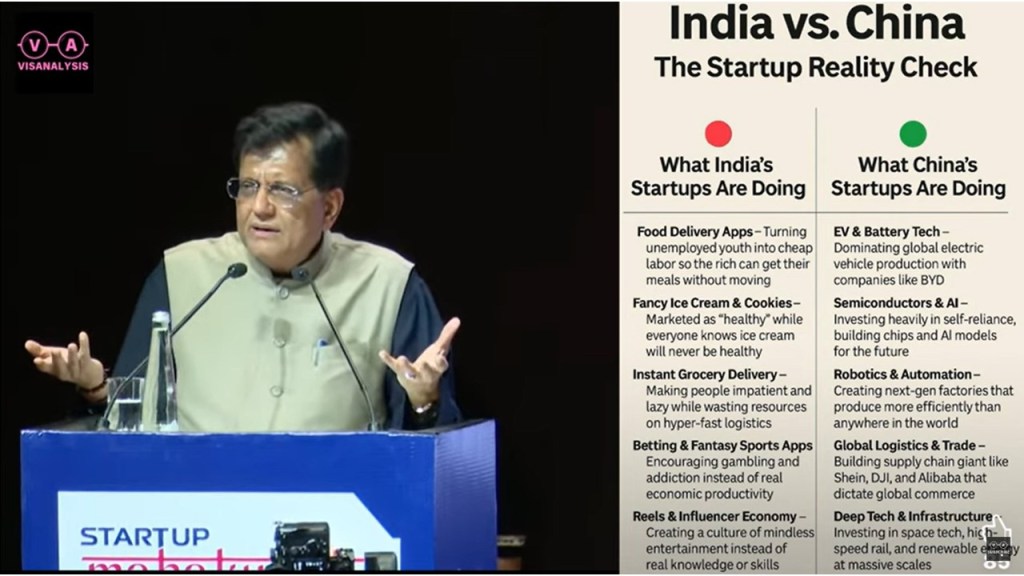
Please click on the image to view the video

There has been divided response on the social media, while some suggest that at least some one has accepted the dire situation and raised a concern there are others who point out that government needs to pitch in for the success of their deep tech startups.

One of the founders of a semiconductor startup took to reddit platform responding to Mr. Goyals remarks as follows:

“We are a semiconductor startup. Started in 2018. Stopped wasting our time trying to get Indian clients—private sector, government or defense,” he wrote. He described the procurement process as discouraging and non-committal, citing repeated instances where officials responded to proposals with statements like: “You build it, then we’ll decide,” or “We won’t buy—go find whether there is a market for this.”

Semiconductor founder hits back at Piyush Goyal’s ‘ice cream or chips’ remark

The point he made was who would fund these deep tech research without the visibility of returns from the same? Who would invest the time and energy in something which might or might not click? In any business the most important part is visibility of returns, path to success.

Another perspective to counter the Commerce Minister

We all understand that world we knew is fast perishing and there is a paradigm shift awaiting at the horizon. New Leaders will be those who wield the Technology. In current scenario it seems that China has left whole world behind. Whether it is Automotives (dominated by Europeans) or Aerospace & Defence (dominated by US) or manufacturing (dominated by Japan) or any other field. While there is merit to both these arguments what’s important is to find a way to tread this path.

From Startups perspective: following points are important and need intervention.

  1. What support can governments (state and central) offer to startups. We need a proper plan and execution for the same.
  2. India has a done a commendable job jumping from 142 (in 2014) to 63 (in 2020) but what ahead of that. New businesses still struggle with basic support and regulatory hurdles.
  3. Deep Tech surely will need significant initial capital and the product lifecycle will be longer. This is where they expect a handholding. There has to be a funding charter for these Deep Tech. Clear identification of areas, clearly defined economic zones, strategies, etc.
  4. Post the product readiness what is important is market acceptance. There is a need of governments adopting the newer tech products in their ecosystem to boost this initial resistance.

From Governments Perspective: following points are important and need resolution.

  1. While we can always point fingers what’s also important is inclination of the industry towards R&D. If we take even the biggest of the Organizations in India, the focus on R&D has been abysmal. India R&D expenditure is roughly 1/10th that of China or US. On GDP scale its just 0.65% while in US and China its well above 2~3% (on there scale of GDP) even a small country like Israel does @ 5% of GDP. Majority of this comes from Public Sector. Private sector lags completely in this. In US and China private sector does the major weightlifting.
  2. We have a very strong domestic markets for Automotive, Clothes, Electronics, mobile phones. Name any private sector company who built a world class product in India in last several years. Even the 2-Wheeler companies that boast of exports do so in third world countries. There is no aspiration to become a globally renowned product. The focus of Indian corporates has been returns & this needs to change.
  3. Look at the Indian IT sector. For last 2 / 3 decades we are happy being the service providers (cheap labour) to the world. why have so called IT giants never tried to build a product? What are the R&D budgets of these mammoth companies? And if they will not invest in R&D who will and who should?
  4. Now when we look at the pharma industry that is an appreciable picture. They spend significant amounts in R&D. Do pain stacking research for years and as a fruit, they hold almost 40% of the US generic medicine market. Other industries need to take a lesson from these companies.

To conclude, I suppose both the Industry and Governments have to work closely, hand-in-hand to change this scenario for the greater good. Industry needs to be braver and more adventurous while governments need to support this adventure and ensure they have a strong ground for this.

These are a few pointers that I could think of, but I would surely love to hear your perspective on this topic. So please do contribute your views in the comments below.
Ola and Uber: Unpacking the Ride-Hailing Crisis in India

We all were used to good comfortable rides in Ola & Uber. The convenience, safety, AC, comfort, etc. all in all it was a dream come true about 8~10 years back. Majority of customers shifted from extorting Auto-Rickshaws to these Cabs. As a cherry on top, you need not plan the trip or hold the taxi for day it was a point-to-point connectivity. This looked like and amazing Win-Win model for all, Drivers, Customers & the company. So, what has gone wrong in last 3~4 years that all the pieces of this amazing puzzle are falling apart.

Let’s deep dive to understand. For context let’s start from the very Start.

India was primarily an Auto commute economy, so majority of people used to use Auto rikshaw / Tuk Tuk as the means for last mile connectivity. For the more privileged or corporate people there was always some neighbouring travel agency, who took cab bookings. This was a very unorganised market, with lot of third-party transactions where reliability was always a problem. Then came the era of Radio Taxis (booking cabs on call centre). This was efficient but needed advance planning.

In this scenario emerged 2 companies who had a very organised structure and gave a very strong alternative to above options. Advantage they offered:

  1. Clean Cabs with friendly driver.
  2. You had a voice with cab and driver rating.
  3. Point-to-Point connectivity, almost instantly.
  4. All this at reasonable prices.

Indian consumers were elated that at last someone addressed their pain.

What was in it for Drivers:

  1. Freedom from Job – Own business, they were now completely on their own. They could decide their daily income / time to work / take leaves whenever they needed.
  2. Incentives and good strong income.
  3. Respectable option to blue collar jobs and problems with those jobs. Overtime etc.

So, what was company gaining out of this:

They provided a platform to bridge the gap between customers and service providers and charged a fee for the same.

Prima Facie this looks very rosy, so where did the problems start. To know this let’s understand the business model of Ola and Uber.

Any platform needs 2 main constituents Customer and Seller. Now at the start you will have to lure both of them on your platforms. Why lure? Because there is already a system existent and you are proposing a new one, change needs a catalyst. So, these platform companies follow this broad business model:

  1. Bait: So, to lure the customers and sellers, they throw the bait. Discounts, Incentives, high margins, etc. At this step all platform business lose cash (in financial terms this is called Cash Burn).
  2. Network: In this step the current customers and sellers influence / aspire other customers and sellers. This is called customer acquisition strategy. At this step as well the cash burn is continuing.
  3. Stabilising: Once there is good activity and strong customer base and sellers are added, what starts happening is old existing systems collapse and both customers and sellers rely more on this new system. You become addictive to this way and this becomes the new normal. This is the time of reduced incentives, reduced discounts, etc. but your comfort still pushes you to use this system.
  4. Monetize: This is commercial step where the platform starts dictating the terms. Now you feel trapped but are left with no major choices as rest of the ecosystem is already dead. Now you remain stuck and platforms can now milk you for profits. They have supreme control on entire process. This is where comes Surge Pricing, all your home / office rides are costlier, odd times or odd locations pick up or drops become costlier. None of this extra income generated goes to driver (may be a small percentage) all is pocketed by platform.

Now that we understand the business model, you would have guessed what happened to Auto rikshaw and private travel agents and call cabs. They slowly died due to no business or joined the Ola Uber bandwagon. Customers shifted to Ola Uber as it was very convenient, book a cab from comfort of your home or Office and cab will be at your door steps in less than 10 Mins.

Now let’s see what went wrong in all this:

  1. Many people under the influence of other drivers joined Ola and Uber even leaving their Jobs for extra money and independence. But once they started pushing down driver income what happened was Loans, Cabs, expenses all started creating issues for drivers & in this trouble COVID hit.
  2. Due this autocratic behaviour of both, post COVID no major drivers joined them back.
  3. Customers were already facing issues as now the cabs were not all clean, drivers were not all civilised, ACs were not working. Due to low income only bad cabs and bad drivers remained with Ola & Uber.
  4. Now since Ola Uber had less drivers and for customers there was no major option demand was high – They could not focus on quality of cabs. Quality went spiralling down.
  5. Drivers used to cancel rides / ask for cash / just did not turn up. Especially in North and South India.
  6. This also hit the reliability of these cabs & customers started searching for alternatives. Price was still not an issue but reliability and service was becoming a pain.

In this some smart people started new ventures whether it is all electric taxis like BLU / GrEL / iNDrive etc, or some call centre kind of services like SAVAARI / Carbazar / BroomBoom etc. providing reliable and clean experience.

 These above options are helpful for preplanned activities. As far as instant cab bookings are concerned the piece of convenience is still on OLA Uber side. But customers are now smart and they are picking and choosing service providers.

So, what could have these Ride Hailing platforms done better, I suppose:

  1. This business depends on both the consumer and cab drivers. So, to sustain they should find a Win-Win solution. They need to be customer centric while having a strong eye to vehicle owners’ profitability. A transparent charging mechanism could be a great start.
  2. As platform fees – they should charge fixed fees per trip to vehicle owners. To monetize they can go with slab wise incentive on monthly revenue generated by Cab owners.
  3. They need to make cab drivers accountable for cancelling the rides and also take that ownership. It cant happen that you take 25~30% of the charges and 0% of accountability.
  4. Focus should be on Cabs Quality, cleanliness, safety, driver etiquettes, availability & no cancellations. Customers need a reliable solution and this should take care of that.

So as a wrap up following seem to be primary reasons why I think Ola Uber are having a tough time:

  1. Unreliable & Unclean cabs deteriorating the overall experience.
  2. Autocratic behaviour and monopolistic push towards drivers.
  3. Utter negligence to the Quality.
  4. Transparent pricing, better quality of cars and service could turn the tables back in there favour

If you feel there could be more ways or ideas that could make this better for us do feel free to share your views or ideas in comment box below. Also if you have any suggestions / comments do share..

4P’s Analysis: iPhone – Apple

In the mobile world iPhone launch has been the pivotal moment. The phones world is divided in 2 era’s – before iPhone and After iPhone. Just imagine the first gen phones they looked like a silver brick with buttons on it and then came the iPhone. What we did with those bricks was to do voice calls, a few games, and a calendar. What we do now is host of activities. It has changed the way we access the world and the whole overload of information on it. There are more than 3 billion iPhones sold since its launch.

It’s not that no one had tried earlier, there was IBM with their Simon Device – Touch screen, email, To-Do, Fax, etc. but again the design was more like a brick and weight as well.

IBM’s SIMON & iPhone Gen 1

Just check out the following video to understand the few following things:

Steve Jobs introducing the iPhone at MacWorld 2007:

Product: He introduces iPhone as 3 in 1 – a iPod + Phone + Internet Communicator.

Positioning: Smart and user-friendly design & Comparison between prevalent phones.

Promotion: Look at the way he sets the tone and then announces and ten launches the Product.

To get a bit more in specific details:

Product:

Innovation is one word that defines the Product strategy for iPhone. Apple invests a lot in R&D. This keeps them always ahead of the game in comparison with the competitors. iphone has always been the leader in its segment whether you talk about the touch screen or single slide button to silent a phone or a very high security on data. It has always been a strategy for the designers to bring out a very attractive feature that consumers have never dreamed about. This novelty value helps apple to attract and retain their customers. The loyalty of customers is so strong that you would see a mile long lines outside the mall to buy the new iphone on the launch of it.

Normally the Business schools teach you to find a problem that is pestering the customers, then find a solution to resolve this and Viola you are in business. But iPhone has always launched products which customers were not even expecting. No customer thought of a Touch Screen phone / iPod (instead of Walkman) / iMac.

These were absolute revolutionary products.

Promotion:

The promotion strategy as well is quite different, you would not see a common advertisement like its competitors. Apple focuses on a certain feature in a phone and keeps promoting the same. If you see the recent billboards – it pushes the idea that the images captured from iPhone are professional level. In-fact you do not see an iPhone on the hoarding. Earlier they had promoted the voice command “SIRI” or the email function a few years back. They have always refrained from bombarding ads / celebrity endorsements / high budget ad spends, etc.

In short Apple has always based their promotion strategy on “Focus on Value” rather than the product itself. They always advertised a feature (value). Another aspect they use for their promotion is voice of the customer. Their customers are their strongest Brand Ambassadors. Apple has one of the highest brand loyalties from existing customers, if you love Apple products there is a very small chance that you will leave the brand for other. This is enhanced now by many companies, remember the launch of FB Metaverse. Apple is also working on something similar – to keep the customers engaged in the ecosystem that these big brands create. This opens a plethora of possibilities and revenue streams for such organizations.

Positioning:

iPhone launched when Blackberry (BB) was the darling with all the corporates. BB provided the corporate employees with the email on the go. The sync with the handheld was the most amazing feature for which BB was a sole strong option. The BB positioning was for age group of 30-55 years. This went on for several years and then BB ventured to target the younger generation for their product. On the wake of this iPhone launched and they exactly nailed this shortcoming from BB. As a device the appeal of BB was not as unique and strong as was with iPhone.

According to Rubicon Consulting – around 2012, 3 Million iPhones activated by AT&T in US and around half of those customers were below 30 years of age. When they had strongly captured this blue ocean for BB, they went for the BB strong turf & launched the iPhone that can sync with MS Outlook on a PC. This move targeted to penetrate the core customer base of BB and today BB is seen nowhere while Apple holds around 15~20% market share of the global smart phone market

Do read this article for more details on market shares of the mobile market.

Pricing:

Apple has always used premium pricing strategy. Skimming Strategy – Pricing the product high, sacrificing mass sales for profitability. This helps keep high profits but also risks pirated products. To ensure the piracy problem Apple added a novelty value / pride of ownership angle. This has widely helped them to keep prices consistently high.

There had been legal battles that Apple purposely slows down older UI to push people to buy new variants of the iPhone but today we will park this strategy aside and focus on current scenario.

Apple has also successfully used the Decoy Pricing strategy. While launching the models keep the mid-level model at such a price that it makes the top end look value buy. Thus, the anticipation is to trick the customer mind into buying the expensive version and yet feeling he has got the value.

For more details on Pricing strategy read the following article:

To conclude, I would say that Apple has a revolutionary product, and they use aggressive pricing, smart positioning, and conservative promotion strategy.

2022 – The EV Year?

The way the traction is building in the EV space – it seems that 2022 will be a PIVOTAL Year for the same. OLA has already launched their vehicles with a huge Roar. They went even ahead and urged the entire two-wheeler Industry to go all electric by 2025.

Model wise Comparison for major players.

In July approx. 30~35% of all 3-Wheeler sold has been Electric.

With many new models launching / huge investments being announced / many new entrants throwing their hats in the rings – it seems that the EV market will be getting hotter over calendar year – 2022

HERO MOTORS:

  • HERO Motors has already installed 1650 charging stations and plans to increase these to 20,000 with in next 2 years.
  • Their study reveals that the EV sales increased strongly in areas where they have these stations. This is even when people charge their vehicles at home.

KINETIC GREEN:

  • They have sold 30,000 E – Rickshaws till date in Cargo Applications.
  • They Plan to invest approx. INR. 300 Cr in next 3~4 Years.

TATA GROUP:

  • TATA Motors launched Tigor Sedan in EV this month with following features:
  • Sub 10 Lakh Segment
  • Warranty for Battery & Motor – 8 Years / 160,000 Kms.
  • 0-60 Kms speed in less than 6 SEC.
  • Tigor Express T – @ 200 Kms range in single charge.

MURUGAPPA GROUP:

RETROFITTING KITS

INVESTMENTS IN EV SPACE

Refer the below table from Autocar PRO – on Investments raised by Indian EV Startups. This space has been buzzing with many companies raising huge money and the biggest being OLA.

Indian EV Startups – Funding Raised

E-Rickshaw Zones identified in Gurugram in APRIL.

So all in all it looks like we will be in interesting times in 2022, with EV taking the front stage. It will also be interesting to see how the established players take this challenge and how many of new companies survive the test of time.

Feel free to share your feed backs or any other interesting information in the comments below.

Top 5 Management Mistakes

We all look up to someone, to guide us, to give us directions and instructions when we are stuck. In our office we call them Managers or Management. Does this make them the holy grail? The pious people who are not prone to make any mistakes? Off course no, they too can make mistakes and below are a few, I have seen many of them, make.

Communication in today’s world is a Sorcerer’s stone; you may hit gold every time if you use this tool to perfection. Concise and crisp communication at all levels is the need of the hour. A lot of corporate companies, I have seen are losing ground on this. This keeps you miles away from the realistic situation.

At times managements are worried about issues and discuss at length in meetings. These issues actually did not crop up as someone took actions nobody knew about.  Or even complete reverse, an issue which was never discussed and crops up to lose a lot of valuable resources.

It’s advisable to have a crisp 15 min call / week with all levels and stake holders.

Managements should never refrain from communication, never shy away from interaction. Customers, employees, suppliers, labors, all this communication builds a sense of confidence and camaraderie towards the organization & its goal.

Solutions are always simple; our perception of the solution is complicated. There is a widely circulated story of a Soap Production line, many a times the soap box used to be dispatched empty. Multiple experts worked on this problem, fancy machines, X-Ray tech was all implemented to avoid the same. When a labor was asked to suggest a solution he simply put a table fan on the assembly line. Empty soap box was light and so used to fly away.  Solutions are always simple.

No one does this on purpose, but we all human beings are evolved, thinking that problems should have a difficult solution. And that’s the reason why the problems exist, in the first place. We need to satisfy our Pseudo Ego.

The Best thing for any management is to keep things as simple as possible. Instead of talking heavy jargon’s that do not make anyone understand the data being discussed; focus should be on conveying the information. The message about the ethics, strategy, expectations, directions, etc.  should reach deep down in the hierarchy of the organization. The onus is always on management to percolate these messages. This helps everyone contribute to one goal, else people work as per their perceptions of priorities.

It is always a tendency to think “let’s clean our house and then focus on the world”. But, this doesn’t come true always. Management should have a balanced approach towards inward and outward focus. Yes, it’s important to put the house in order, but how much time and energy to be spent on that, what time should you dedicate, what approach, how much resource, etc. are also issues to be looked into.  The organization should not lose the lead in the market to clean the house.

Any business thrives only on a thriving customer base. So, the major focus of any management should be Customers: their views, their expectations, their choices, their preferences. If you focus to deliver these, internal operations must automatically fall in place.

Managements often feel that they are in control of their business, without even setting the foot outside their elite glass cabins and corner offices. This is seldom true. There has to be an industry feedback system. Whether it comes from customers / suppliers / competitors / peers / colleagues, but interaction has to happen.

Only when you move in market meet your customers, suppliers, peers do you really get the feel of where the industry head & tail winds are.  Are your plans aligned to it or not? Is your organization ready for that, in that time frame? Is there a need of course correction?

Many a times, managers are driven with a concept of self-righteousness about their decisions. This is a classic trap many managers walk into. The key here is to understand the realities and facts rather than a blind faith on people or self.

It’s important to trust employees, but it is as well good, to check directly with the customers or subordinates. Whether the employee you trust is still in-line with them? Is he portraying the factual picture to you or just his perception of the same? I do not advocate distrusting your team members. But its always good to have a reality check.

This simple trick can save millions for organizations, which could be simply lost in focusing on a wrong market segment, wrong resource allocation, improper product launches, inappropriate capital investments, etc.

Decisions should be based only on facts and facts alone. A simple principle, to drive a profitable business.

Hope you agree with my point of view on the things Top Management (or for that matter any manager) should refrain from? I would like to know your views / any additional points you want to add to this list. Please feel free to comment below or write to me.

4P’s Analysis: Model S – TESLA

What kind of a persona are you? Flaunting your possessions or silent and heavy, who does the possessions do the talking? Well CAR is one of the tools that does exactly that. Define the owners persona.

Do you love the BMW / Merc? Or Are you the quintessential “Kitna Deti Hain?” guy? Or Are you more of a value for money kind? Or maybe  the Environment Savior? This is where the concepts of Marketing like Target Marketing, Product, Promotion, Positioning, Price etc. comes into picture.

Let us just analyse the Tesla Model S for the Marketing concepts mentioned above.

So what is the Target market for a Tesla Model S. It’s a young & mid aged crowd of 26 to 50 years, great job and a good family income of approx. 90 to 100K USD per annum. People who needed a Luxury vehicle & have around 2 to 4 hours’ drive time each day. They wanted this long rides to be luxurious and enjoyable.

Tesla positioned the Model S, as a vehicle with Style, comfort, luxury, safety and reliability. They have developed a product that addresses, both the wants and needs of its customers. Their target customers wanted a stylised car with comfort and safety. They also needed the car to be luxurious and reliable. So Tesla has positioned themselves in both segments the Luxurious and Electric Cars, with the kind of features it offers.

So looking at the Product offering with Model S. It offers following – 3 battery pack options – 40 kWH, 50 kWh, 85 kWH, drive range of more than 300 miles on single charge, Top speed of 125 miles, 0 – 60 in 5.6 Seconds, 17” LCD touch screen to control the entire vehicles, navigation, communication, cabin controls, vehicle data, etc. Steering mounted controls that seamlessly integrate with the above features. The ease of plug and charge with 120V wall sockets is also an appealing product feature.

This huge list of features, at a price point of slight more than USD 60K makes Model S a steal compared with its competitors. So similar to Model S is a Lexus GS which is just below the USD 60K mark, Mercedes Benz hybrid S400 is priced at USD 90K+ & Porsche Cayenne S Hybrid is priced at USD 65K. So all in all it an be said that Tesla is calling the pricing shots in its segments and competitors have to align themselves to the Tesla Pricing strategy.

Click here to know more on : Tesla’s Product Specs / Features:

When last year Tesla mentioned that they are in no hurry to launch in India, it makes one thing very clear, that they have also chosen there locations very smartly. Tesla has launched their operations primarily in US, Europe & China.  It shows that it is aware that for EV’s to be sold, what is important is the strong and reliable power grid and experimenting rich people. They are in no hurry to push their product in wider areas and then get in trouble for service. This appeals a strong Place strategy similar to their Promotion strategy.

Tesla is not a mass market car and thus they refrain from Television promotion, the promotion has been more to the target market with print media like in magazines – Business Week, Forbes, etc. Also they have promoted their brand with a message “We do not inherit EARTH from our ancestor, we borrow it from our children.” Pushing the envelop of being a environment caring company. Apart from advertising Tesla also arranges to that their vehicles on a documentary road trips – to make the cars feel more popular. This is a quite innovative and efficient promotion strategy.

Tesla has a heavy trust on Social Media Marketing. Elon is master at this tactics of attracting & building the audience, may it be smoking weed or breaking the glass of his launch cars, he does that with such fluency and then you are glued to his rebellious personality.

Elon Musk: Leveraging the Social Media to effortlessly promote TESLA

On Typical basis – Tesla is taking the Technology sales approach than the product sales approach. You see the launches are similar to Apple iPhone launches / Windows launches. They are not taking the typical Automotive launch / Marketing approaches at all.

We are all aware that the traditional marketing campaigns are going nowhere now and for Technology Products (non-mass products – to start with) will only dent your pockets without the traction on sales.

Refer another nice article on: Tesla Marketing Strategy

So to conclude this article, In mere 16 years what Tesla has achieved against its well established competitors on there own turf is absolutely appreciable. They have been making great headway in the field with strong out of the box marketing and product strategies.

They are disrupting not only the Automotive Market but also the whole value chain & reinventing the process making it more interactive than unilateral.

If you have liked this post do check another similar one:

4P’s Analysis: iPhone – Apple

CRISIS : A STEPPING STONE

The times of crisis always changes the world. Great Individuals and Organisations lead this change and mediocre one’s perish. The crisis is always the best time to introspect. Focus should be inwards. What it actually gives, is time to make necessary, but neglected changes. This is true for both individuals & organisations. This looks a very obvious step but where people majorly fail is in implementation / action.

Having said that let me help you in charting this course / steps : What are these changes? How can one find what changes are needed? What to be done to implement the changes?

Let’s Dive in:

How can you find what changes are needed?

The most important aspect to change is to accept that change is required. Many individuals and organisations are always on negation mode. We always feel that we are doing the best we can and there is nothing to improve or nothing to change. So the following steps are very important:

  1. Accept that there is always scope of improvement in the process / efficiency.
  2. Find the bottle necks / areas where there is always a hand to mouth situation.
  3. Find areas that are always part of discussions –

INDIVIDUAL: I cannot find time / I cannot read so much / I do not get motivated / etc. ORGANISATIONS: we have less people / we have older machines / we have less time for the same.

In short – List the NEGATIVE comments that are commonly discussed, find solutions for the same.

Examples are better teachers & easy for understanding the concept:

INDIVIDUAL: I never get time for reading books / exercise, is it only me? I am sure its with all of us. Use this Crisis to change that. How? You have been working from home – so you are saving time on travelling to office / to customers. Utilise this time for reading & exercise. You can best do alternate day and do both the activities. Take control of your time.

ORGANISATIONS: Setting processes correct is always a neglected issue when the sales is going good. Organisations have least priority on the same & rightly so, Sales is the first priority as it generate revenue / resources are overloaded. Now, the crisis is best time, as in here resources are not overloaded. Use this opportunity to set correct processes to increase overall efficiency.

How can we implement the change?

Once you have identified the task half the battle is won. You can only make progress if you take actions on the same.

  1. Have a brain storming session with stake holders to understand what are the pain points & how they can be eliminated.
  2. List out the highest priority pain points, elimination of which will significantly increase efficiency.
  3. Put a clear action plan with roles and responsibilities.
  4. Keep tracking the progress and make changes in line with the plan.

So to sum up following steps can make Crisis as a stepping stone instead of a showstopper.

  1. Identify the bottlenecks / pain points.
  2. Create a plan for resolution / elimination of the same with clear responsibility.
  3. Track progress and guide way to final achievement – Increase in efficiency.

I can confidently say that this will surely help in bouncing back better and managing costs to the “Tee”.

I would also like to know your ideas to increase efficiency, please share the same in comments.

5 Steps to achieve Customer Intimacy

Today we not only talk about customer delight / customer satisfaction we talk about customer intimacy.

What is Customer Intimacy?

How to make customers interested in your business?

How to achieve Customer Intimacy?

These steps should help you have a lot of important information, considerably easily & lightning fast.

5 SUCCESSFUL BUSINESS STRATEGIES

Strategy by definition means: A plan of action designed to achieve a long term or overall aim.

Every organisation defines there strategy for business and while some fail many succeed at it. So what is the difference? Difference is highlighted in below Quote perfectly:

Above all, Success in business requires two things: a winning competitive strategy & superb organisational execution

Stephen Covey

In this article I will take you through the examples and details of some strategies but first let’s just simplify the Strategy into 5 broad categories:

  1. Product based: In  this the Product is the centre of strategy.
  2. Customer based: Customer Experience / requirements at the centre.
  3. Idea / Concept based: Basically a Gap in Supply – Demand / Demand creation is at the centre of strategy.
  4. Demographics based: A certain region / class / age etc. is being focused in this Strategy.
  5. Competition: Targeting competition and its products to highlight your products / offerings.

Now lets dive in to details in each of these categories:

PRODUCT BASED:

 This is for both the Product & Service. Here the main focus is on developing the Product or Service that bridges the gap between the demand and supply to make a strong business case.

Let’s talk about IKEA – there moto has been to create a better every day life for masses. They have variety of quality products which are functional, budget priced, stylish. So they managed to find a niche for themselves and developed a product / brand to serve and monetise.

On service front, we all know a lot of apps in this category – food delivery, shared cabs, radio cabs, logo design, etc.

To discuss about an innovative idea is a small company Dunzo. In layman’s language they are the local courier, minus the disadvantage of dropping the package at the courier shop. They found the pain point and provided an end – to – end solution. Pick-up and Drop packages and that too at a reasonable cost. My daughters school book set was delivered by Dunzo during the last phase of lock-down. They not only deliver documents but cakes as well.

In here the Product Idea is in front of every ones eyes, but the main aspect is finding the Gap and then executing the delivery strategy that is most important.

CUSTOMER BASED:

On a regular basis we find companies launching products, competing in markets, beating the competition & winning the sales – this is typical Product based strategy. Another strategy is Customer Based (I call this a copy-cat strategy). You do not need to be innovative, you just need to have money power to buyout or a strong team to replicate the product.

Microsoft has pioneered this game by far, than any other brand. Its simple for them, let some one do the effort of product launch, testing the market, troubleshooting, etc. Once the product is established, MS will either buyout the company / launch a similar product.

Right in the start they bagged a order from IBM for the operating system, then acquired a small company Quick & Dirty Operating Systems (QDOS), modified there OS to make MS-DOS.

Excel was influenced by VisiCalc & Lotus 1-2-3. Word was heavily similar to a popular software Word Perfect. Powerpoint was acquired from a small San-Fransico company.

To dethrone a popular browser – Netscape, they licensed a browser from Spyglass.

X-Box – Sony Playstation / Nintendo.

There are many such examples. Currently they are focusing on Google with MS team sitting right in Bay Area, in backyards of google.

With its base product the Windows ruling the PC market – they have a strong platform for cross selling. Look at MS Team’s a competitive product to Webex, they are offering it with MS Office as a bundle deal.

IDEA / CONCEPT BASED:

Japan has been predominantly as Tea drinking country, in 1970’s Nestle wanted to push coffee to this tea drinking nation. They hired a psychologist Clotaire Rapaille who mentioned that Japan has no connect with coffee and they will not accept the same,  he suggested Nestle to add coffee flavours in there sweets. This made the young Japanese people accept the taste of coffee from a very young age. This brought about an amazing benefit to Nestle.

From nil coffee sales in 1970 – Today Japan is 3rd Largest Importer of Coffee in the world. In the instant coffee segment Nestle leads the  market.

So the example is self-explanatory on how an idea / concept based strategy is implemented, driven and can create a huge first mover advantage in the target markets.

The key to this strategy is knowing the pulse of the market. Understand the culture, create an emotional bonding for your product / service.

DEMOGRAPHICS BASED:

In India people are very innovative and they can sell any product on the demographic base. Will the comb be different for men & women? Does the soap need to be different? razor / toothpaste / shampoos / cars / etc.

But day in day out we see this happening on our TV. Toothpaste with a Cartoon character – targeted to your kids, with pink, floral design at your wife and regular targeted at you. So a family of 3 buys 3 toothpastes.

Recently you would have seen a health drink Women’s Horlicks,  Different versions of Shampoos are being targeted at Men & Women, even Face wash are being differentiated between Men and Women.

Above may seem and intelligent idea but these are not so good examples.

Let’s again look at Nestle. When they launched the famous Kit Kat in japan they slightly changed the brand name to “Kitto Katto”. This was a runaway success due to  its similarity to the famous phrase “Kitto Katsu” which means “never fail” / “you will win”. So Kit Kat also became a famous gift product.

Another such example is of the ITC’s Engage Pocket Perfume. They absolutely created a market niche with this innovative product packaging – Pocket Perfumes. Engage (ITC Brand) was first to put perfume in a small pocket friendly packaging. They targeted the teenagers, who would always want to be ready and are always on the go. It wasn’t easy to carry heavy bottles of perfume everywhere, so they created this niche and all other players had to follow.

COMPETITION BASED:

We have all seen a lot of Rivalries & competition targeting, Cola Vs Pepsi, Kingfisher Vs Jet, Microsoft Vs Apple. Main motive here in, is always to highlight what rival misses and take a pot shot at competition.

Let’s look at a little know rivalry which went on to edge of the wire. Dunkin Donuts Vs Starbucks in USA.

Dunkin was a regular Donuts & fast food joint until around 2000. Then they decided to enter the coffee market, launched a variety of espresso’s, latte’s & cappuccino’s  in 2003. Around 2006 they started punching above their weight at Starbucks the by far a market leader.

They targeted Starbucks for there menu, lined up with Italian styled names on it. They advertised with customers having difficulty to order there brew. Though Starbucks did not indulge in this verbal battle, they insisted that quality of their coffee beans is way better than a fast food joint coffee seller.

Dunkin then launched a campaign “America runs on Dunkin” & there CEO also highlighted that they are a beverage company.

Today 60+ % of the coffee market in US is dominated by these 2 players. Around 40% by Starbucks and 20% by Dunkin.

What Dunkin did was by targeting a market leader in coffee segment they made a space for themselves. They created a alternate name in customer minds. So a coffee drinker searches for Starbucks / Dunkin.

So to conclude: It solely depends on organisations and there managements on which strategy they want to play in the markets. its also possible that at one time – multiple strategies could be played in for same products / different products.

Hope you liked this article – please subscribe to not miss such articles.