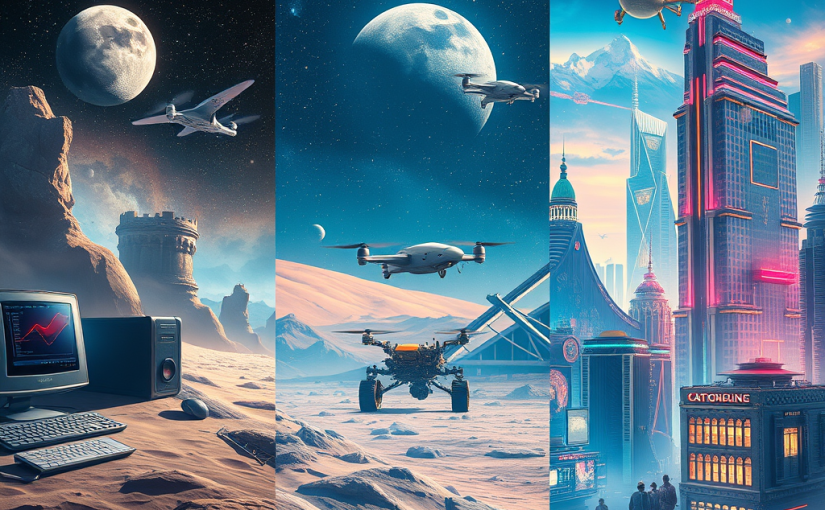
Technology’s Evolution: Past, Present, and Future Insights

If we try to take the overview of where we were at the start of 21st Century to where we are now and where we would be by mid of 21st Century. I anticipate a phenomenal change. This 50 Years will be a giant leap for the mankind.

When we take an account in 2050 the world could be completely different from where we started around 2000.

Today we see following:

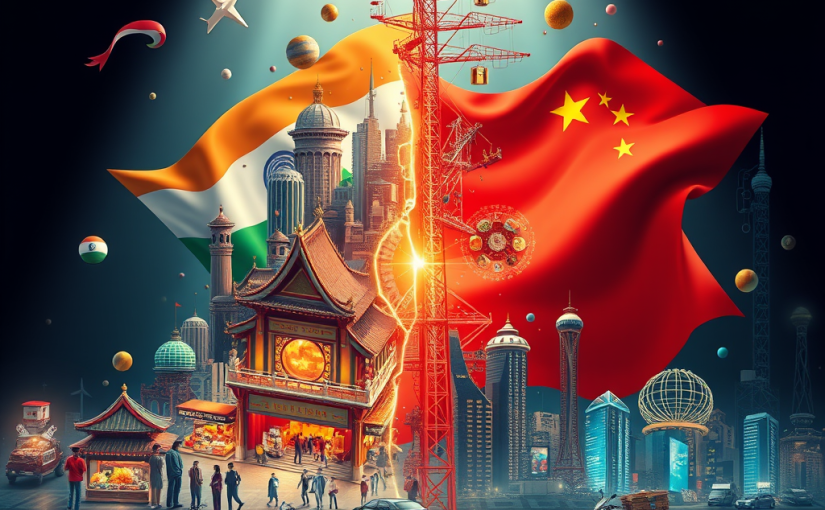
  1. From Technology leadership for US and Europe the baton seems to be shifting East words to China.
  2. From worlds super economies European countries are now leading the bankruptcy lists.
  3. From a 3rd world country India now is in Top 5 strongest global economies.
  4. It seems India & China will be torchbearers to take the world forward from here on to 2050.

Let’s just jump in and take account of What was, What is & What could be.

IT: The Past: What Was

When we talk about 2000 the first thing that’s hits us is Y2K. Brief background for the uninitiated. All the software systems were written with only 2-digit nomination for year, e.g. 94, 95, etc. When 2000 arrived, there was a fear that the whole system will get a reset to “00” & the world as we know can have its Dooms Day. Indian IT companies came to the foray and they amended all the software systems to 4-digit nomination. This highlights 2 most important aspects:  The advent and rise of Software Technology to the world along with advent and rise of India on global stage as reliable IT service provider.

Open AI to Buy Statsig for 11 Billion Dollars

By Mid-2000’s there was another Technology out burst the Internet which ended in a famous dot.com bubble but Internet stayed and ever since has been becoming more and more wide spread touching lives and shaping the new world.

IT: Today: What Is

If we compare the scenario midway to this 50 Years journey – both IT (computers & Internet) are integral parts of our lives and work. They control so much in today’s world that we might be pushed to stone age in case they cease to exist. Things that no one thought about in 2000’s like – Phones in pocket, international communications at finger tips with laptop & internet, OTT movies being streamed directly from cloud to your home, connected devices, purchases from the comfort of your couch, digital payments, and another 1000’s of features that we today just take for granted.

But, the evolution till date and what is about to come with new inventions like cloud, mobile connectivity, AI, etc. the world we are about to see will be very different and could be unrecognizable by 2050 for some one who being born today.

IT: Future: What could be

My expectation is that technology could jump to a point where the world could see redefinition of connectivity. We could see machines, buildings, cities, etc communicating with each other to make this world a better place. We could operate any system or device from anywhere in the world on a mass adoption level. We could see Robots guarding our streets, working on machines, and do all redundant jobs, AI (this is a big debatable issue) could be a game changer and will be instrumental in all decision makings whether its personal, institutional or governmental.

I am only limited by my imagination on what could be…

Manufacturing: Past: What was:

The early 2000’s saw emergence of another eastern country China as the World’s Factory. The accession to WTO opened a lot of products to be manufactured in China and supplied to the world and China did not blink they kept climbing the ladder and becoming a dominant force in Global Manufacturing supply chain.

This era also saw an emergence of low-cost cars – mass adoption of cars and evolution in manufacturing at scale. This was start of globalisation. European Union was launched with EURO as their currency. The complete global supply chains were rewritten. USA & Russia dominated in defence, Space & Economics, Europe in automotive, mechanisation & robotics. 

Manufacturing: Today: What Is:

Today we see a bit different from yesteryears. The word is again getting polarised with China+1, Europe+1, etc. US wants their manufacturing jobs back. China has significantly leap frogged with “Dark Factories” & Robots on assembly lines. They are making a strong headway in Automotive and have taken European giants by storm. They are building high-tech cars, 3D Printed homes, Robots as service providers, cleaners, drone deliveries, etc.

They have wreaking havoc with “Debt Trap” on not so well doing economies like Sub-Saharan countries, Sri-Lanka, Pakistan, etc. All in all, China is dominating the manufacturing & technology landscape of today.

India by launching PLI & “Make in India” initiatives, US with “MAGA”, etc. are trying to gain back control from China to reduce the global dependence on the Dragon.

Manufacturing: Future: What could be:

The key words for future of manufacturing are efficient, automation & diversified. My expectation is that the dependence on China will surely reduce. We will see emergence of newer countries like Brazil, Vietnam, Thailand, etc. doing good in this scenario. Over next 20~25 odd years, human might not be seen in factories, they will be run by robots and AI. Automotive would move to cleaner tech like EV, Hydrogen, etc. World will see a strong emergence of cleaner electricity as major power source moving away from fossils. I see, Self Drive Cars, Flying Cars, Drones, etc a mass adopted technologies from current concepts. Homes, Bridges, Rockets, etc. could be made with 3D Printing. Human Implants will be a reality, we might not need to carry a phone it could just be a sim implant.   

I am only limited by my imagination on what could be…

Let’s move to the next big ticket which will change the future of mankind.

Space Technology: Past: What was:

Space has always been a huge area of interest and an opportunity to showcase once tech prowess. While the space technology war has been quite old between US, Russia, China. 2000’s was a revolutionary year with ISS – International Space Station. It marked continuous presence of humans in space. In the last 2 decades the major milestones achieved in Space Tech are, China’s manned craft capabilities, launch of SpaceX first private space research organisation, China’s own space station, India aggressively putting their own satellites INSAT in space. We saw advent of satellite TV, concept of Starlink, Moon exploratory missions, MARS missions, etc. the 2000’s decade has been foundation of Space Tech and has brought a lot of things like Material Innovation, advanced positioning systems, advanced communication systems, etc to mainstream.

Space challenges of 2000 – NASA

Space Technology: Present: What is:

In today’s scenario India and China have also taken huge leaps in space exploration. India’s Mars mission was an ultra-low-cost mission. India in a world first – also landed its rover on the dark side of moon. China has been first to land a rover on far side of moon. China also landed a rover on Mars becoming second country ahead of USA / Russia. SpaceX has successfully demonstrated the reuse of rockets for satellite propulsion, India’s Aditya mission is a study mission for the SUN. USA is working on Deep Space exploration, Space Station in moons orbit, space tourism, etc.

So, we are developing a lot of technologies and trying to expand the boundaries of known science and technologies.

Space Technology: Future: What could be:

Let me be candid here – I am limited by my imagination….. 🙂

I will not be surprised if we see, manned flights to Mars and beyond, if we see a huge network of satellites for communication, Supervision of world, lightning-fast satellite communications, colonisation in space, space tourism, AI playing a major role in assistance, much advanced materials with higher strength and lower weight. I would not be surprised if space travel becomes as normal as taking flights.

Exploring the deep space with telescopes. Orbital Hotels, colonies on Moon and Mars. Space station tourism.

So, to summarise this while the past for all Information Technology, Manufacturing & Space Tech was a strong foundation, present is quite progressive and we did come quite a long way, but, as it is always a hockey stick journey, I anticipate that the future progress for all three will be much faster over next 20~25 years.

I am not sure how many of us will live to see the world of tomorrow but it surely is bringing some very enigmatic changes.    

India vs China: The Startup Ecosystem Debate

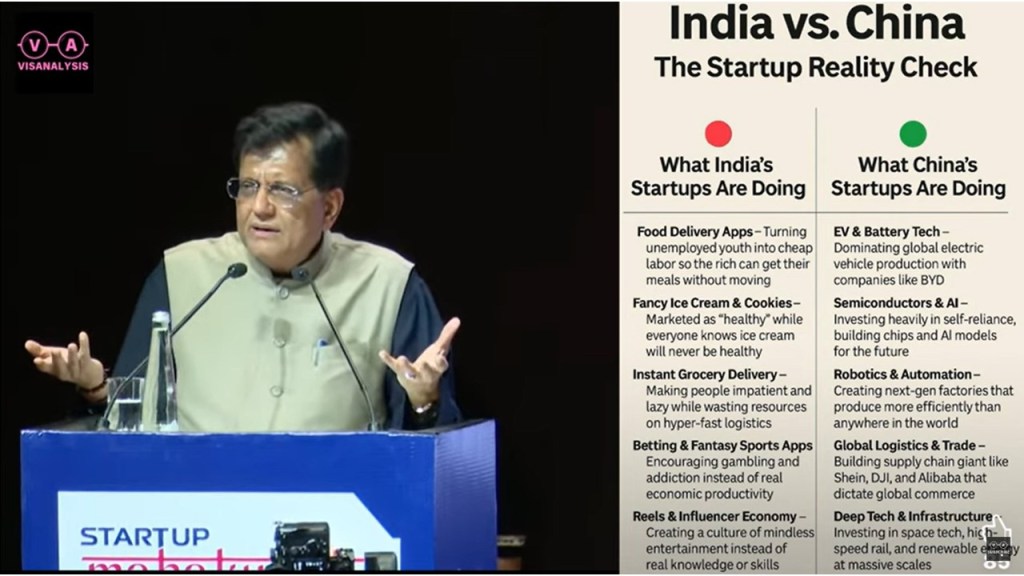
Currently there is a roaring debate on startup ecosystem of India Vs China. This photo was already doing rounds in social media but what added the fuel to the fire is our commerce minister discussing this in the Startup Mahakumbh. He took a deep dig on our startups and mentioned that what we are doing is “entrepreneurship” and “not startup”.

Please click on the image to view the video

There has been divided response on the social media, while some suggest that at least some one has accepted the dire situation and raised a concern there are others who point out that government needs to pitch in for the success of their deep tech startups.

One of the founders of a semiconductor startup took to reddit platform responding to Mr. Goyals remarks as follows:

“We are a semiconductor startup. Started in 2018. Stopped wasting our time trying to get Indian clients—private sector, government or defense,” he wrote. He described the procurement process as discouraging and non-committal, citing repeated instances where officials responded to proposals with statements like: “You build it, then we’ll decide,” or “We won’t buy—go find whether there is a market for this.”

Semiconductor founder hits back at Piyush Goyal’s ‘ice cream or chips’ remark

The point he made was who would fund these deep tech research without the visibility of returns from the same? Who would invest the time and energy in something which might or might not click? In any business the most important part is visibility of returns, path to success.

Another perspective to counter the Commerce Minister

We all understand that world we knew is fast perishing and there is a paradigm shift awaiting at the horizon. New Leaders will be those who wield the Technology. In current scenario it seems that China has left whole world behind. Whether it is Automotives (dominated by Europeans) or Aerospace & Defence (dominated by US) or manufacturing (dominated by Japan) or any other field. While there is merit to both these arguments what’s important is to find a way to tread this path.

From Startups perspective: following points are important and need intervention.

  1. What support can governments (state and central) offer to startups. We need a proper plan and execution for the same.
  2. India has a done a commendable job jumping from 142 (in 2014) to 63 (in 2020) but what ahead of that. New businesses still struggle with basic support and regulatory hurdles.
  3. Deep Tech surely will need significant initial capital and the product lifecycle will be longer. This is where they expect a handholding. There has to be a funding charter for these Deep Tech. Clear identification of areas, clearly defined economic zones, strategies, etc.
  4. Post the product readiness what is important is market acceptance. There is a need of governments adopting the newer tech products in their ecosystem to boost this initial resistance.

From Governments Perspective: following points are important and need resolution.

  1. While we can always point fingers what’s also important is inclination of the industry towards R&D. If we take even the biggest of the Organizations in India, the focus on R&D has been abysmal. India R&D expenditure is roughly 1/10th that of China or US. On GDP scale its just 0.65% while in US and China its well above 2~3% (on there scale of GDP) even a small country like Israel does @ 5% of GDP. Majority of this comes from Public Sector. Private sector lags completely in this. In US and China private sector does the major weightlifting.
  2. We have a very strong domestic markets for Automotive, Clothes, Electronics, mobile phones. Name any private sector company who built a world class product in India in last several years. Even the 2-Wheeler companies that boast of exports do so in third world countries. There is no aspiration to become a globally renowned product. The focus of Indian corporates has been returns & this needs to change.
  3. Look at the Indian IT sector. For last 2 / 3 decades we are happy being the service providers (cheap labour) to the world. why have so called IT giants never tried to build a product? What are the R&D budgets of these mammoth companies? And if they will not invest in R&D who will and who should?
  4. Now when we look at the pharma industry that is an appreciable picture. They spend significant amounts in R&D. Do pain stacking research for years and as a fruit, they hold almost 40% of the US generic medicine market. Other industries need to take a lesson from these companies.

To conclude, I suppose both the Industry and Governments have to work closely, hand-in-hand to change this scenario for the greater good. Industry needs to be braver and more adventurous while governments need to support this adventure and ensure they have a strong ground for this.

These are a few pointers that I could think of, but I would surely love to hear your perspective on this topic. So please do contribute your views in the comments below.

Ola and Uber: Unpacking the Ride-Hailing Crisis in India

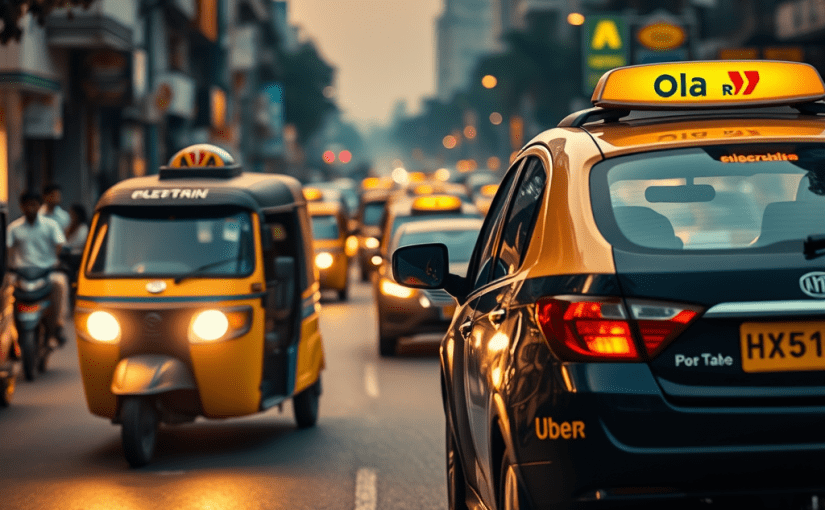
We all were used to good comfortable rides in Ola & Uber. The convenience, safety, AC, comfort, etc. all in all it was a dream come true about 8~10 years back. Majority of customers shifted from extorting Auto-Rickshaws to these Cabs. As a cherry on top, you need not plan the trip or hold the taxi for day it was a point-to-point connectivity. This looked like and amazing Win-Win model for all, Drivers, Customers & the company. So, what has gone wrong in last 3~4 years that all the pieces of this amazing puzzle are falling apart.

Let’s deep dive to understand. For context let’s start from the very Start.

India was primarily an Auto commute economy, so majority of people used to use Auto rikshaw / Tuk Tuk as the means for last mile connectivity. For the more privileged or corporate people there was always some neighbouring travel agency, who took cab bookings. This was a very unorganised market, with lot of third-party transactions where reliability was always a problem. Then came the era of Radio Taxis (booking cabs on call centre). This was efficient but needed advance planning.

In this scenario emerged 2 companies who had a very organised structure and gave a very strong alternative to above options. Advantage they offered:

  1. Clean Cabs with friendly driver.
  2. You had a voice with cab and driver rating.
  3. Point-to-Point connectivity, almost instantly.
  4. All this at reasonable prices.

Indian consumers were elated that at last someone addressed their pain.

What was in it for Drivers:

  1. Freedom from Job – Own business, they were now completely on their own. They could decide their daily income / time to work / take leaves whenever they needed.
  2. Incentives and good strong income.
  3. Respectable option to blue collar jobs and problems with those jobs. Overtime etc.

So, what was company gaining out of this:

They provided a platform to bridge the gap between customers and service providers and charged a fee for the same.

Prima Facie this looks very rosy, so where did the problems start. To know this let’s understand the business model of Ola and Uber.

Any platform needs 2 main constituents Customer and Seller. Now at the start you will have to lure both of them on your platforms. Why lure? Because there is already a system existent and you are proposing a new one, change needs a catalyst. So, these platform companies follow this broad business model:

  1. Bait: So, to lure the customers and sellers, they throw the bait. Discounts, Incentives, high margins, etc. At this step all platform business lose cash (in financial terms this is called Cash Burn).
  2. Network: In this step the current customers and sellers influence / aspire other customers and sellers. This is called customer acquisition strategy. At this step as well the cash burn is continuing.
  3. Stabilising: Once there is good activity and strong customer base and sellers are added, what starts happening is old existing systems collapse and both customers and sellers rely more on this new system. You become addictive to this way and this becomes the new normal. This is the time of reduced incentives, reduced discounts, etc. but your comfort still pushes you to use this system.
  4. Monetize: This is commercial step where the platform starts dictating the terms. Now you feel trapped but are left with no major choices as rest of the ecosystem is already dead. Now you remain stuck and platforms can now milk you for profits. They have supreme control on entire process. This is where comes Surge Pricing, all your home / office rides are costlier, odd times or odd locations pick up or drops become costlier. None of this extra income generated goes to driver (may be a small percentage) all is pocketed by platform.

Now that we understand the business model, you would have guessed what happened to Auto rikshaw and private travel agents and call cabs. They slowly died due to no business or joined the Ola Uber bandwagon. Customers shifted to Ola Uber as it was very convenient, book a cab from comfort of your home or Office and cab will be at your door steps in less than 10 Mins.

Now let’s see what went wrong in all this:

  1. Many people under the influence of other drivers joined Ola and Uber even leaving their Jobs for extra money and independence. But once they started pushing down driver income what happened was Loans, Cabs, expenses all started creating issues for drivers & in this trouble COVID hit.
  2. Due this autocratic behaviour of both, post COVID no major drivers joined them back.
  3. Customers were already facing issues as now the cabs were not all clean, drivers were not all civilised, ACs were not working. Due to low income only bad cabs and bad drivers remained with Ola & Uber.
  4. Now since Ola Uber had less drivers and for customers there was no major option demand was high – They could not focus on quality of cabs. Quality went spiralling down.
  5. Drivers used to cancel rides / ask for cash / just did not turn up. Especially in North and South India.
  6. This also hit the reliability of these cabs & customers started searching for alternatives. Price was still not an issue but reliability and service was becoming a pain.

In this some smart people started new ventures whether it is all electric taxis like BLU / GrEL / iNDrive etc, or some call centre kind of services like SAVAARI / Carbazar / BroomBoom etc. providing reliable and clean experience.

 These above options are helpful for preplanned activities. As far as instant cab bookings are concerned the piece of convenience is still on OLA Uber side. But customers are now smart and they are picking and choosing service providers.

So, what could have these Ride Hailing platforms done better, I suppose:

  1. This business depends on both the consumer and cab drivers. So, to sustain they should find a Win-Win solution. They need to be customer centric while having a strong eye to vehicle owners’ profitability. A transparent charging mechanism could be a great start.
  2. As platform fees – they should charge fixed fees per trip to vehicle owners. To monetize they can go with slab wise incentive on monthly revenue generated by Cab owners.
  3. They need to make cab drivers accountable for cancelling the rides and also take that ownership. It cant happen that you take 25~30% of the charges and 0% of accountability.
  4. Focus should be on Cabs Quality, cleanliness, safety, driver etiquettes, availability & no cancellations. Customers need a reliable solution and this should take care of that.

So as a wrap up following seem to be primary reasons why I think Ola Uber are having a tough time:

  1. Unreliable & Unclean cabs deteriorating the overall experience.
  2. Autocratic behaviour and monopolistic push towards drivers.
  3. Utter negligence to the Quality.
  4. Transparent pricing, better quality of cars and service could turn the tables back in there favour

If you feel there could be more ways or ideas that could make this better for us do feel free to share your views or ideas in comment box below. Also if you have any suggestions / comments do share..

The Future of EVs: Trends and Insights for 2025